
What if you wrote a film, gave everything to get it made and wanted just one chance to prove yourself?
Peter Farrelly’s behind-the-scenes drama explores the ambition, sacrifice and creative conviction that helped bring Rocky to the screen.
I Play Rocky turns that question into an affecting account of Sylvester Stallone’s struggle before and during the making of Rocky. The 2026 biographical drama revisits the uncertainty behind the Oscar-winning film that introduced Rocky Balboa to audiences in 1976.
Directed by Peter Farrelly and written by Peter Gamble, the film stars Anthony Ippolito alongside AnnaSophia Robb, Toby Kebbell, P. J. Byrne, Jay Duplass, Matt Dillon, Stephan James and Tracy Letts. Produced by FilmNation Entertainment, Baha Productions and Fireside Films, it follows an aspiring actor whose refusal to surrender his dream becomes both his greatest strength and his most difficult burden.
The film’s appeal lies in that tension. We know where Stallone’s story eventually leads. What matters here is how convincingly I Play Rocky makes us feel the uncertainty that came before.
Anthony Ippolito’s Performance as Sylvester Stallone
Anthony Ippolito gives a remarkable performance as the young Sylvester Stallone. Having previously portrayed Al Pacino in The Offer, he returns to the challenge of embodying a recognisable screen figure.
Yet his work here goes beyond physical resemblance. He captures Stallone’s distinctive speech patterns, movement and posture while finding the vulnerability beneath the determination.
His performance conveys the frustration of someone who believes he has something to offer but cannot persuade the industry to see it. Confidence and insecurity coexist, making his stubbornness understandable even when his choices appear risky.
The result is more compelling than a straightforward impersonation. Ippolito creates a character who feels recognisably Stallone without allowing the familiar mannerisms to overwhelm the man.
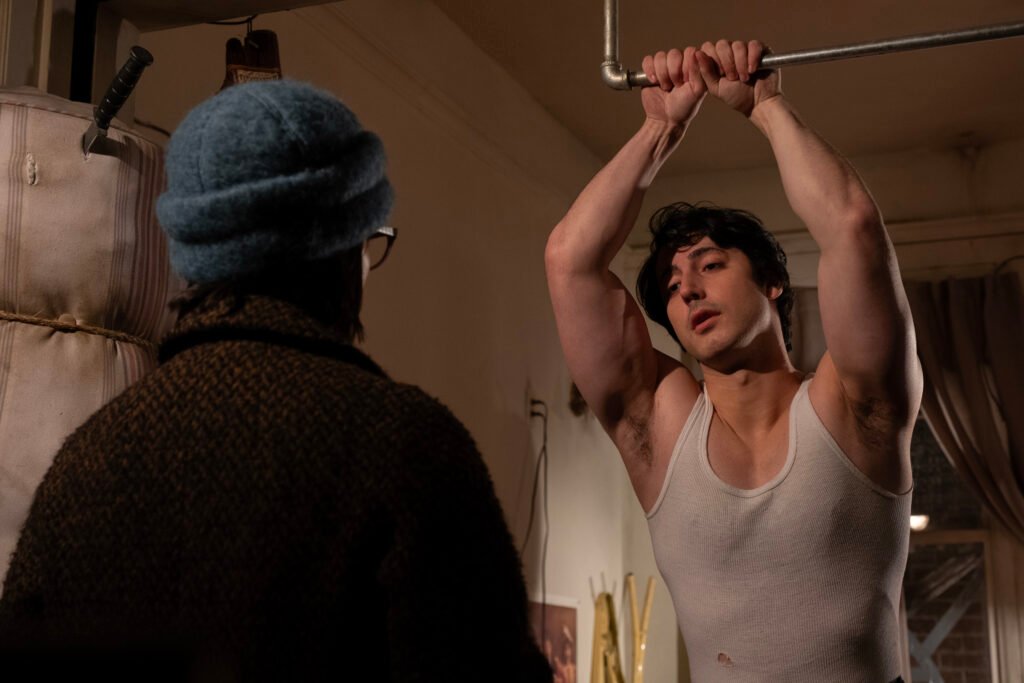
(L to R) Kiki Seto as Talia Shire and Anthony Ippolito as Sylvester Stallone in I PLAY ROCKY, from Amazon MGM Studios.
Photo Credit: Claire Folger
© 2026 Amazon Content Services LLC. All Rights Reserved.
The Story Behind the Making of Rocky
The film introduces Stallone as a struggling actor moving between jobs, facing rejection and trying to survive financial hardship. His ambition remains clear, but the route towards it is anything but certain.
What makes this section engaging is the relationship between his professional frustration and his everyday circumstances. Becoming an actor is not an abstract ambition. It shapes his decisions, strains his relationships and determines how he responds to opportunities.
Writing eventually offers a way forward. Rather than waiting indefinitely for someone else to cast him, Stallone creates a character he believes he should play himself.
That shift gives I Play Rocky its emotional centre. The screenplay becomes more than a piece of work to sell. It represents a chance to take control of a career that has repeatedly stalled.
The film understands the appeal of that idea without losing sight of its cost. Believing in yourself is easier to celebrate in retrospect than it is to sustain when success remains uncertain.
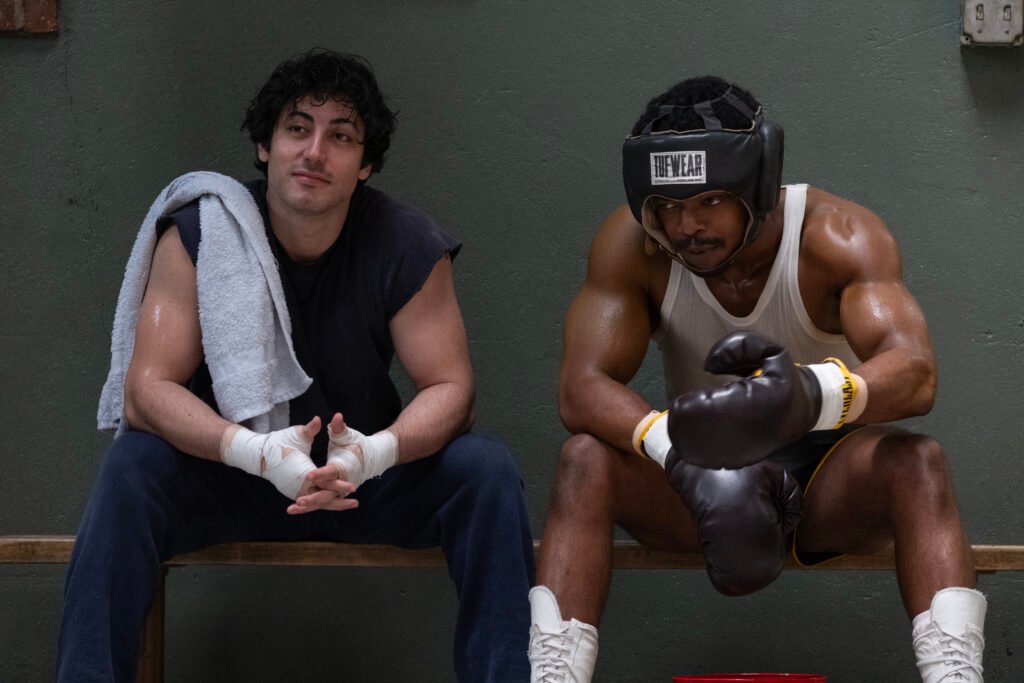
(L to R) Anthony Ippolito as Sylvester Stallone and Stephen James as Carl Weathers in I PLAY ROCKY, from Amazon MGM Studios.
Photo Credit: Claire Folger
© 2026 Amazon Content Services LLC. All Rights Reserved.
Butkus and the Personal Cost of the Struggle
The storyline involving Butkus brings Stallone’s financial difficulties into sharper emotional focus.
The film depicts his painful decision to part with his beloved dog when he can no longer afford to keep him. Buying him back after securing the Rocky deal then becomes more than a moment of relief. It marks the recovery of something personal that hardship had forced him to surrender.
This relationship gives the story a welcome intimacy. Away from negotiations and career ambitions, it reminds us that financial insecurity affects ordinary attachments as much as professional possibilities.
For audiences familiar with Butkus from Rocky, the sequence also creates a connection between the private struggle and the film that would eventually emerge from it.
AnnaSophia Robb Brings Warmth to Sasha Czack
AnnaSophia Robb plays Sasha Czack, Stallone’s first wife, with warmth, intelligence and resolve.
The film presents Sasha as an actress and photographer with her own creative identity, rather than simply a reassuring presence beside the protagonist. Her encouragement helps Stallone recognise that writing could provide the opportunity acting auditions have failed to deliver.
Robb makes that support feel practical as well as emotional. She brings light to a difficult chapter without erasing the pressure surrounding the relationship.
Her performance also gives the film an important counterbalance. Where Stallone’s ambition can become consuming, Sasha’s presence reconnects the story with the person living alongside that ambition.
Their relationship is most affecting when encouragement and exhaustion occupy the same emotional space.

Anthony Ippolito stars as Sylvester Stallone in I PLAY ROCKY, from Amazon MGM Studios.
Photo Credit: Claire Folger
© 2026 Amazon Content Services LLC. All Rights Reserved.
The Producers Behind the Opportunity
Toby Kebbell portrays Robert Chartoff, while P. J. Byrne plays Irwin Winkler, the producers whose involvement helps turn Stallone’s screenplay into a film.
The negotiations provide some of the story’s most compelling tension. For Stallone, selling the script without playing Rocky would mean surrendering the opportunity he wrote it to create. For the producers, making the film requires balancing creative belief with practical risk.
Kebbell and Byrne give these exchanges energy and personality. Their characters are not simply gatekeepers standing between an artist and his future. They are participants in a difficult process, trying to find a version of the project that can actually be made.
This perspective strengthens the film’s portrayal of independent production. A screenplay needs conviction, but it also needs collaborators willing to commit their time, resources and reputations.
I Play Rocky is at its most insightful when it shows those different forms of belief coming into alignment.
Matt Dillon, Stephan James and Jay Duplass Strengthen the Supporting Cast
Matt Dillon delivers a striking performance as Frank Stallone Sr., Sylvester’s father.
His portrayal is often uncomfortable, inviting frustration before allowing room for a more complicated response. Dillon makes the character difficult without reducing him to a one-dimensional antagonist.
That emotional friction helps explain the protagonist’s need for recognition. The desire to prove himself does not exist only within the film industry; it also carries a personal history.
Stephan James brings charisma to Carl Weathers, whose performance as Apollo Creed became fundamental to the identity of Rocky.
James gives the role a strong presence, reminding us that the original film’s impact depended on the relationship between its performers, not solely on Stallone’s breakthrough.
Jay Duplass is equally effective as director John G. Avildsen.
Initially blunt and demanding, his character gradually reveals the pressure of shaping a production whose resources are limited but whose creative demands remain substantial. Duplass makes that tension credible, showing how a director’s exacting standards can create conflict while serving the film.
Peter Gamble’s Screenplay and Peter Farrelly’s Direction
Peter Gamble’s screenplay builds its drama around the distance between ambition and opportunity. It gives Stallone a clear objective, then places personal, financial and professional pressures in his path.
The story’s emotional force comes from watching those pressures accumulate. Each apparent breakthrough introduces another compromise or uncertainty.
Farrelly’s direction keeps the emphasis on the people involved. He allows the ensemble to establish relationships that make the production story feel personal rather than procedural.
The challenge is considerable: the audience already knows that Rocky will be made. Nevertheless, the film finds tension in how it happens and in what the process demands of those involved.
Its attention to performance is particularly valuable. The actors create a shared emotional world, making the relationships persuasive even when the broader narrative moves towards an outcome we recognise.
Cinematography, Costumes and Period Atmosphere
The cinematography, costumes and make-up work together to support the period setting without distracting from the performances.
Their contribution is most effective when it reinforces the distance between Stallone’s modest circumstances and the professional world he hopes to enter. The production’s visual coherence helps make that divide tangible.
More importantly, the filmmaking keeps the human stakes in view. Behind the familiar title and eventual success are people dealing with rejection, financial pressure and the possibility of failure.
That is what makes this behind-the-scenes story worth telling. The film is not simply reconstructing a celebrated production. It is exploring the fragile conditions under which an enduring piece of cinema can emerge.
Final Verdict: Is I Play Rocky Worth Watching?
I Play Rocky is an absorbing and deeply affecting account of creative perseverance, led by Anthony Ippolito’s outstanding portrayal of Sylvester Stallone.
Its strongest achievement is making a familiar success story feel personal again. The performances, emotional relationships and attention to the filmmaking process give weight to a journey whose outcome audiences already know.
This is essential viewing for Rocky fans and anyone interested in the realities behind independent filmmaking. It honours the original film’s spirit without forgetting the struggle that made it possible.
I Play Rocky is playing in US theatres.
Rating: 9/10